
Neurodivergent or Disabled?
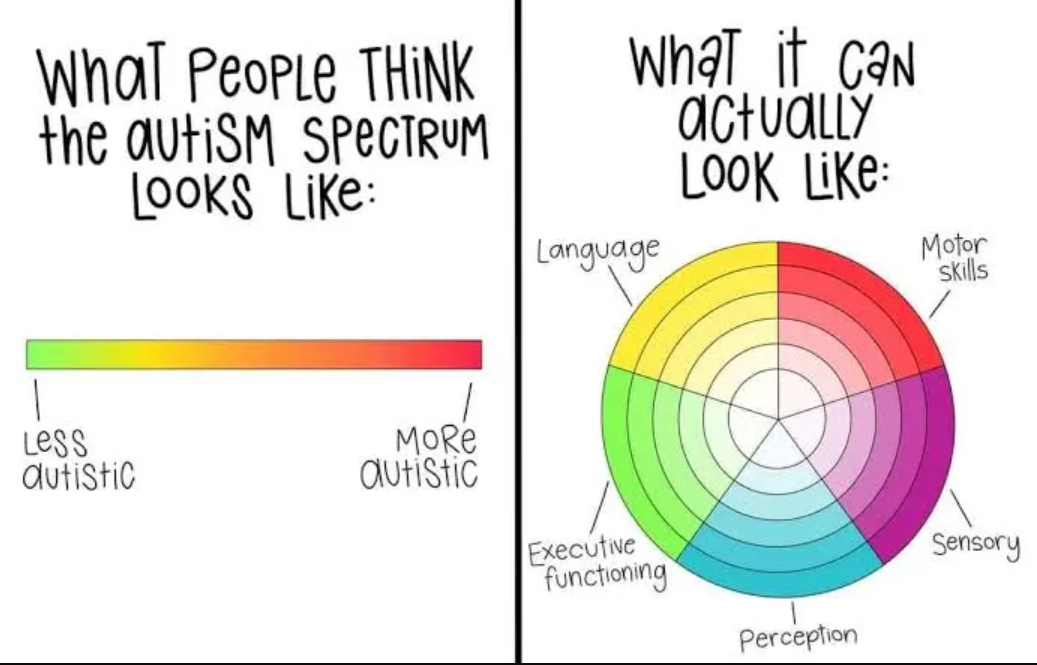
Recent research in autism is revealing that what we previously thought of as “high functioning” and “low functioning” is actually a very harmful metric for assessing or engaging autistic people.
An ND-Friendly approach to understanding Autism (and all other neurodivergent ways of learning and thinking) allows people to recognize that there are multiple strengths and challenges that can be addressed as needed depending on the severity of the challenge.
This is why Individualized Education Plans are CRITICAL for Autistic students – because autistics are not a homogenous group. There is incredible variation in skills, strengths, and more.
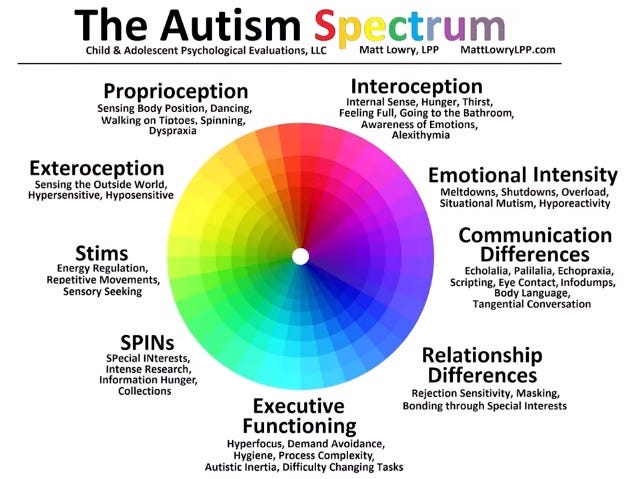
There are so many different types of “mental disabilities” – to the point where people are questioning – or should we say ‘gaslighting’? – the reality of humans existing in a world that is not designed for their flourishing.
Even as educators recognize a variety of learning styles and a variety of metacognition, students are still left being coerced into “masking” or behaving in ways that run counter to their own neurological and biological reality.
An individual with a disability is defined by the ADA as a person who has a physical or mental impairment that substantially limits one or more major life activities, a person who has a history or record of such an impairment, or a person who is perceived by others as having such an impairment.
When we deny the very harsh reality that most students with autism, ADHD, BPD, face as they exist in the school setting, we are setting them up for complex Post Traumatic Stress Syndrome.
What we also fail to realize more often than not is that PTSD can EITHER exacerbate the neurodivergent condition (increasing stims or echolalia, removing capacity for speech, increasing anxiety or depression) or it can mask it (social conditioning to “behave” or hypervigilance can increase capacity for excutive function.
The reality behind these conditions, which the research bears out, is that traditional educational practices can actually further harm neurodivergent individuals.
Neurodiversity takes neurological developments traditionally regarded as atypical or even as diagnosable disorders, such as autism or dyslexia, and conceptualizes them as normal human variation (Jaarsma & Welin, 2012 as quoted in Krzeminska 2019).
When we reframe the conversation around these neurological differences as diversity rather than disability, we acknowledge that many folx who exist in this reality have not only challenges, but also brilliantly unique strengths and gifts to give the world.
In a neurodiversity friendly classroom, we celebrate these differences and invite everyone to showcase their strengths instead of focusing on their challenges.
Relevant Links:
Educator Emily Hammond provides brilliant Neurodiverse Educational Tools on Teachers Pay Teachers. Look up Neurowild on social media as well.
Krzeminska, A., Austin, R. D., Bruyère, S. M., & Hedley, D. (2019). The advantages and challenges of neurodiversity employment in organizations. Journal of Management & Organization, 25(04), 453–463. https://doi.org/10.1017/jmo.2019.58
Center for Inclusive Education. (2024). Understanding Neurodiversity and Its Impact on Disability Perceptions. All Belong Main. https://allbelong.org/understanding-neurodiversity-and-its-impact-on-disability-perceptions#:~:text=Neurodiversity%20suggests%20that%20the%20differences

PACK-IT
Our Values

Passion comes in so many forms, and we want to honor those robust, strong emotions as they emerge – and give them a healthy direction to flow into. If we understand all behavior as communication, then we can see moments of escalation as opportunities for deeper learning – instead of flash points for tempers and misunderstanding.

Ability is the structural framework of skills and technique that help our students thrive. Some of these are standards set by our state governing boards, and some of them are strategic “tricks” to help students navigate the new hybrid world of multiple forms of media. Not all students can learn from lectures – Ability helps diversify their skillset.

More and more, Collaboration is King in the broader world. These days, it is more often about *who* you know and not *what* you know. Companies talk about “right fit” and “team-building” in ways that show their importance. Our students not only work together on various parts of learning, but also learn better strategies for working together – delegation, communication, and more.

It is crucial to develop our “kindness” muscles as we grow. Kindness is not being “nice”or people pleasing. Kindness involves speaking truthfully and honoring the inherent dignity and value in the person in front of you. It reflects a desire for how we want treat one another, and how we want our world to be.

Integrity matches who we are on the inside to how we act and interact in public spaces. Every human being is a leader – even if they are only leading themselves. Leadership has its roots and stability in Integrity – the practice of showing up consistently, with different facets of personality, skill, communication, and relationships *integrated* into our identity. When we practice Integrity, we invite accountability and growth.

Thoughtfulness means being mindful of ourselves, our community, our environment. It can be a pause before replying, it can be a moment of curiosity or inquisitiveness, and it can also be applying knowledge in new ways. When we are “thoughtful” or mindful, we activate our “metacognition” – the place in our brain where we embed our values and beliefs. Thoughtfulness also indicates a level of learning in which we can apply the knowledge to more than just data points. We can make connections, draw conclusions, and apply these things to our life.